

This Edition's Rule: The Game Ball (NFHS Rule 1‑12)
It's the one piece of equipment every play depends on, and yet the game-ball decision trips up more pre-games than it should.
Here's what Rule 1‑12 actually requires.
The ball must meet specifications (Art. 1). It must be the right size and weight for the level, with a legal pebbled cover in an approved shade — and it must bear the NFHS Authenticating Mark.

Quick reference:
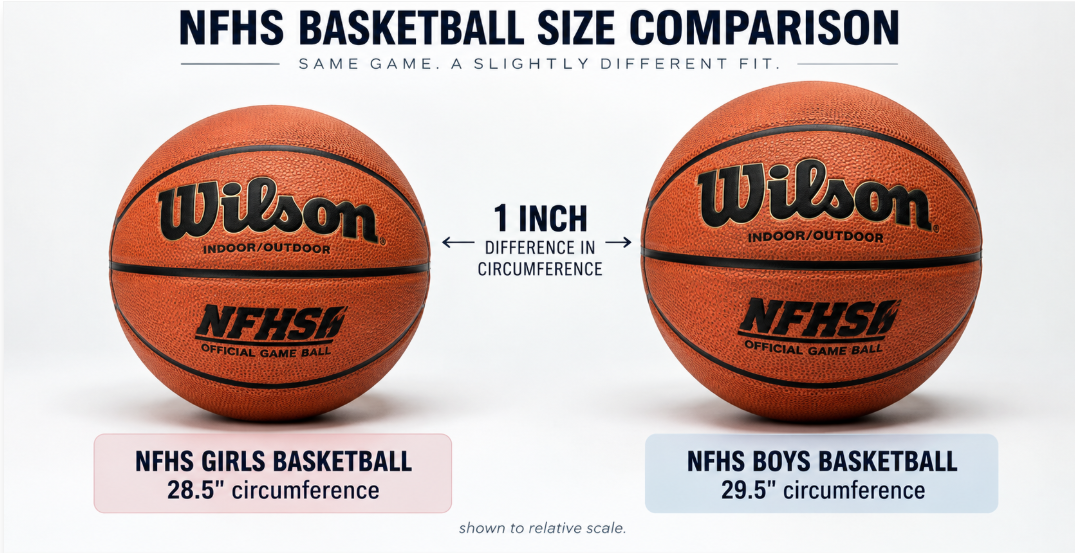
- Boys: circumference 29½–30″, weight 20–22 oz.
- Girls: circumference 28½–29″, weight 18–20 oz.
The home team provides it, but the Referee decides (Art. 3). Two sentences worth memorizing: "The home team shall provide a ball which meets the specifications," and "The referee shall be the sole judge of the legality of the ball and may select a ball provided by the visiting team."
So the home team supplies the ball, but legality isn't their call. It's yours. If the home ball checks out, it's the game ball. If it doesn't, you can go with the visitors' ball.
On the Play 🏀 (Case 1.12.3)
At pregame, the home team hands you their ball, but it's a generic model with no NFHS Authenticating Mark. The visiting team has an approved ball that carries the mark. The home coach insists their ball has "always been fine."
Ruling: Use the visitors' ball. The home team must provide a ball that meets specifications; when it doesn't, the Referee, as sole judge of legality, may select the visiting team's legal ball. Coach preference doesn't override the rule.
You Make the Call - Q&A
Q: Both teams have legal, marked balls. The visitors want to use theirs. Which one do we play with?
A: The home team's. They're responsible for providing the game ball, and if it meets specifications, it's the one we use. You only switch to the visitors' ball if the home ball is not legal.
Q: The home ball is the right ball, but it's clearly under-inflated at tip-off. Legal?
A: Not as-is. The Referee is the sole judge of legality. Have it inflated to specification (or replaced) before it goes into play.
Q: Can a coach demand a different ball simply because their team prefers a certain brand or feel?
A: No. Preference isn't a legality issue. If the provided ball meets Rule 1‑12, it stays in the game.
Bottom line: Home provides, the Referee approves. Check for the NFHS Authenticating Mark and correct size/weight in your pregame. Settle the ball before the tip, not after a complaint.
Here is Rule 1-12. Ball in its entirety.
ART. 1 . . . The ball shall meet the following specifications:

-
Its solid color shall be Pantone Matching System (PMS) Orange 151, Red-Orange 173 or Brown 1535.
-
It shall be spherical.
-
It shall have a deeply-pebbled, granulated surface with horizontally shaped panels bonded tightly to the rubber carcass.
-
The circumference shall be:
-
Within a minimum of 29½ inches to a maximum of 30 inches for high school boys competition.
-
Within a minimum of 28½ inches to a maximum of 29 inches for high school girls competition.
-
-
The weight shall be:
-
Within a minimum of 20 ounces to a maximum of 22 ounces for high school boys competition.
-
Within a minimum of 18 ounces to a maximum of 20 ounces for high school girls competition.
-
-
The black rubber rib separating the panels shall not exceed ¼ inch in width.
-
The ball shall include the NFHS Authenticating Mark. The mark can be displayed in any format shown in Diagram 3. A current list of NFHS authenticated products can be found on the website, nfhs.org, under "Resources."
DIAGRAM 3

ART. 2 . . . The ball shall be inflated to an air pressure such that when it is dropped to the playing surface from a height of 6 feet, measured to the bottom of the ball, it shall rebound to a height, measured to the top of the ball, of not less than 49 inches when it strikes on its least resilient spot, nor more than 54 inches when it strikes on its most resilient spot.
Exception: To be legal, the air pressure which will give the required reaction shall be stamped on it. The pressure for game use shall make the ball bounce legally.
ART. 3 . . . The home team shall provide a ball which meets the specifications. The referee shall be the sole judge of the legality of the ball and may select a ball provided by the visiting team.


Comments (0)