

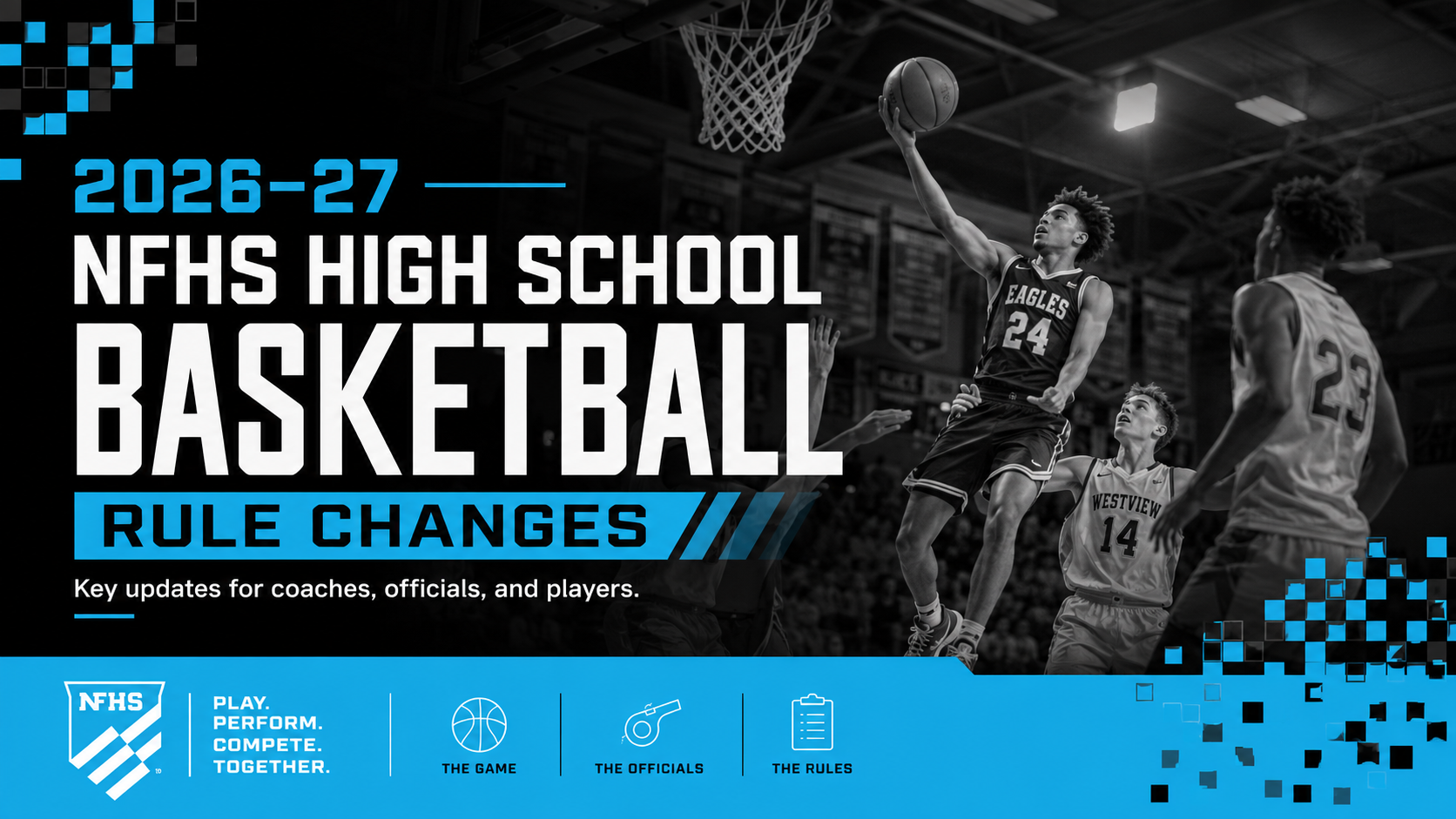

The National Federation of State High School Associations (NFHS) has released its rule changes for the 2026–27 basketball season, and the theme is clear: support the officials and tidy up the rules book. The Basketball Rules Committee approved five changes, most centered on timing accuracy, fair penalty administration, and editorial clarity.
The headline is Rule 5-9-5, which targets late-game clock management. In the final 59.9 seconds of any quarter or overtime, a minimum of 0.3 seconds must now expire from the game clock whenever an inbounds player legally touches a throw-in pass. The provision mirrors the long-standing standard for tap attempts and prevents a team from squeezing an impossible play out of a fraction of a second. Clocks without a tenths-of-a-second display are exempt.
Working alongside it, Rule 5-10-2 (Note) gives officials a practical tool: a visible or silent count may now serve as definite knowledge when correcting a timing error or clock malfunction. When the clock misbehaves, the official's own count counts.
Rule 8-6-4 brings fairness to a chaotic moment. When opposing teams each commit a technical foul during the same dead-ball period, those fouls are now treated as simultaneous and the penalties offset and play resumes at the point of interruption. No free-throw parade, no unearned advantage.
Two changes are housekeeping. Rule 9-2 Penalty restores explicit language confirming that a throw-in violation is administered at the original throw-in spot, and Rule 6-4-4g deletes a now-redundant subsection about warnings for faking being fouled, since current interpretations already cover the procedure.
The committee also issued three points of emphasis. First, player equipment with tooth and mouth protectors must be properly designed and worn, with custom-fitted or molded options required. Second, bench decorum and sportsmanship, with a firm stance on unsporting behavior, prolonged dissent, and inappropriate reactions. Third, physical play and illegal contact, calling for consistent enforcement of post play, illegal screening, and freedom of movement.
Taken together, the 2026–27 package is less about reinventing the game and more about giving officials clearer tools and a cleaner book. For NCOA North officials, the takeaways are simple: know the 0.3-second rule cold, trust your count, and administer double technicals correctly.
Summary of 2026–27 NFHS Basketball Rule Changes
|
Rule |
Description |
Key Details & Application |
|---|---|---|
|
Rule 5-9-5 |
Minimum Clock Expiration on Throw-ins |
In the last 59.9 seconds of any quarter or overtime, a minimum of 0.3 seconds must expire from the game clock when an inbounds player legally touches a throw-in pass. Exempts clocks without tenths-of-a-second displays. |
|
Rule 5-10-2 Note Advertisement

|
Silent Counts for Timing Errors |
Permits officials to use a visible or silent count as definitive knowledge to correct timing errors or clock malfunctions. |
|
Rule 8-6-4 |
Opposing Technical Fouls |
Establishes that technical fouls committed by opposing teams during the same dead-ball period are considered simultaneous, allowing penalties to cancel (offset) and play to resume at the point of interruption. |
|
Rule 9-2 Penalty |
Throw-in Violation Spot Restoration |
Restores explicit language clarifying that the enforcement spot for a throw-in violation is the original throw-in location. |
|
Rule 6-4-4g |
Removal of Faking Language |
Deletes redundant subsection regarding warnings for faking being fouled, as current interpretations already cover the procedure. |
Points of Emphasis for 2026–27
-
Player Equipment: Proper design and usage of tooth and mouth protectors (custom-fitted or molded options required).
-
Bench Decorum & Sportsmanship: Strict management of unsporting behavior, prolonged dissent, and inappropriate reactions.
-
Physical Play and Illegal Contact: Consistent enforcement of post play, illegal screening, and freedom of movement.

Comments (0)